Stability-Aware Reinforcement Learning
RESEARCH CASE STUDY
Stability-Aware Reinforcement Learning
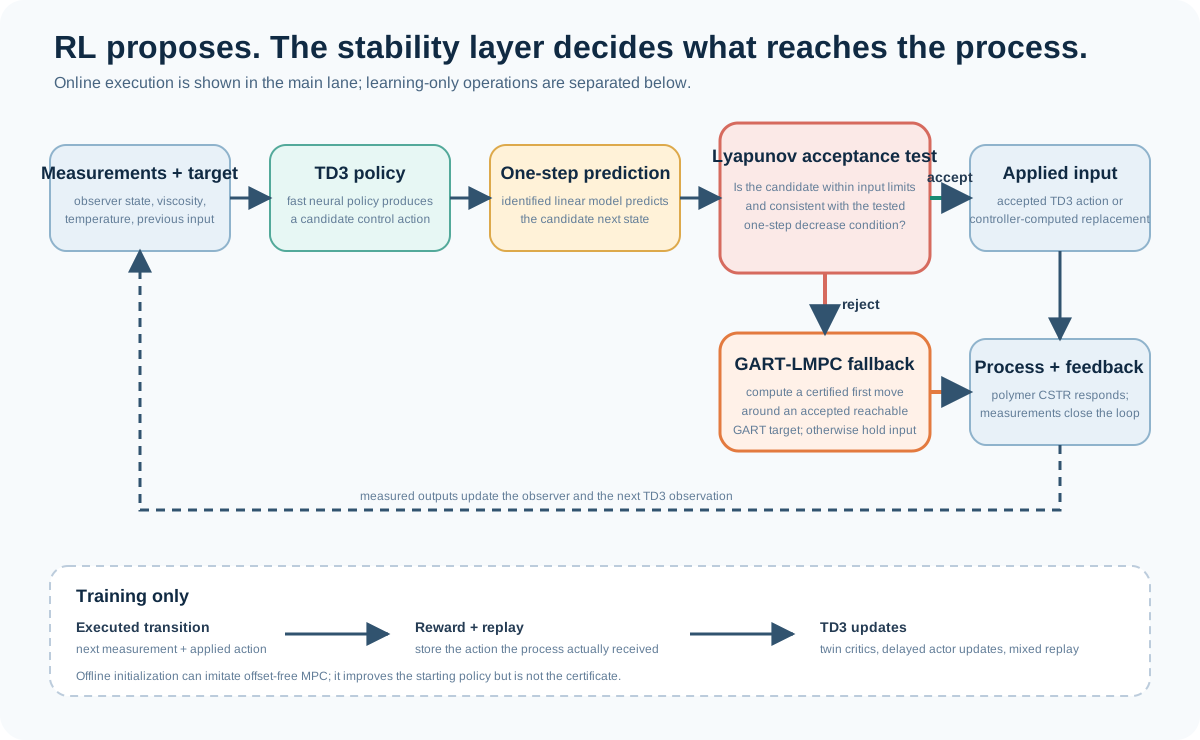
Developed an RL-first control architecture in which TD3 proposes continuous coolant and monomer flow commands and a Lyapunov-guided GART-LMPC layer evaluates each move before it is applied to a simulated polymerization reactor.
System architecture
Contribution and implementation
TD3 receives an observer-based process state, requested viscosity and temperature targets, and previous inputs, then proposes bounded coolant- and monomer-flow commands.
An identified model and accepted Guarded Admissible Reachable Target (GART) evaluate each proposal against model, input, move, and one-step Lyapunov checks. A failed proposal is replaced by a GART-LMPC move; if no usable replacement exists, the implementation clips and holds the previous input without treating that contingency as automatically certified.
MPC first-move examples initialize the TD3 actor before online learning. Twin critics, delayed actor updates, target-policy smoothing, and mixed replay learn from the control action that was actually applied rather than from a rejected proposal.
Implementation: Python · PyTorch · CVXPY
Results and evaluation
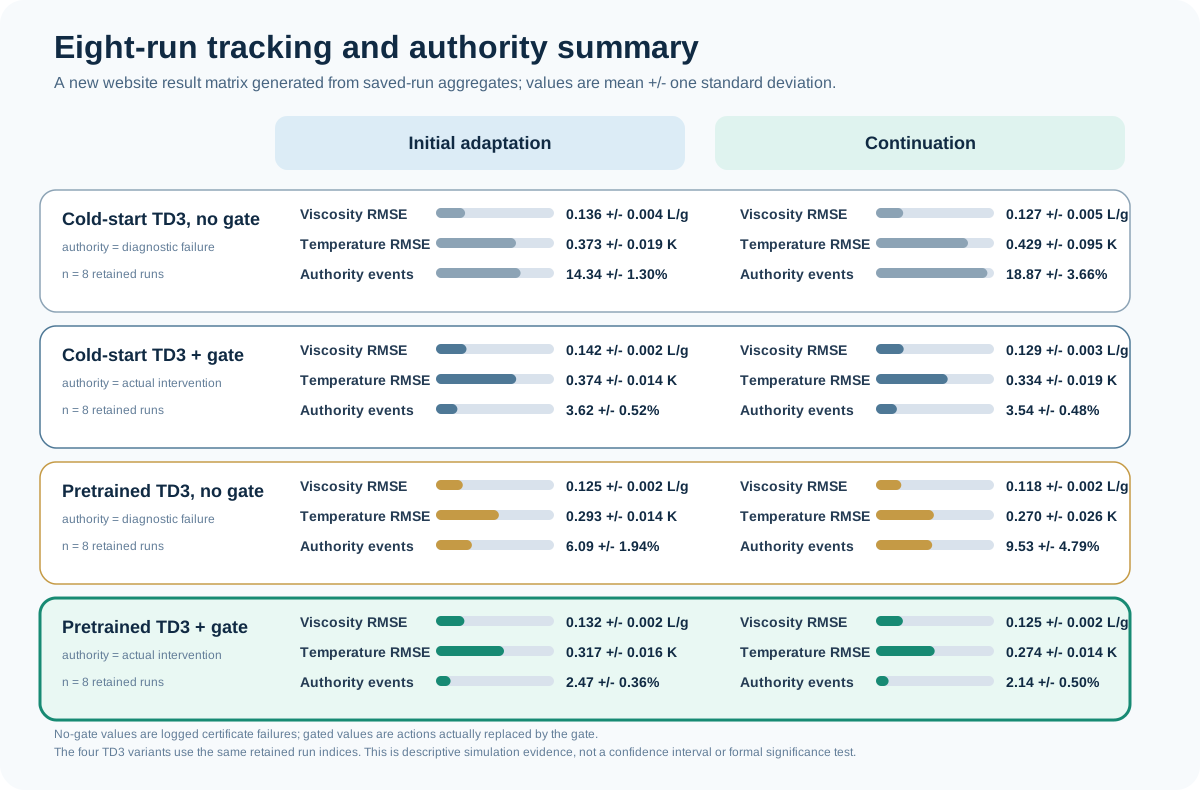
Initial adaptation, eight retained simulation runs per method: gated MPC-pretrained TD3 achieved viscosity RMSE of 0.132 +/- 0.002 L/g, temperature RMSE of 0.317 +/- 0.016 K, and 2.47 +/- 0.36% actual interventions, compared with 0.142 +/- 0.002 L/g, 0.374 +/- 0.014 K, and 3.62 +/- 0.52% for gated cold-start TD3.
Continuation, eight retained simulation runs per method: gated MPC-pretrained TD3 achieved viscosity RMSE of 0.125 +/- 0.002 L/g, temperature RMSE of 0.274 +/- 0.014 K, and 2.14 +/- 0.50% actual interventions, compared with 0.129 +/- 0.003 L/g, 0.334 +/- 0.019 K, and 3.54 +/- 0.48% for gated cold-start TD3.
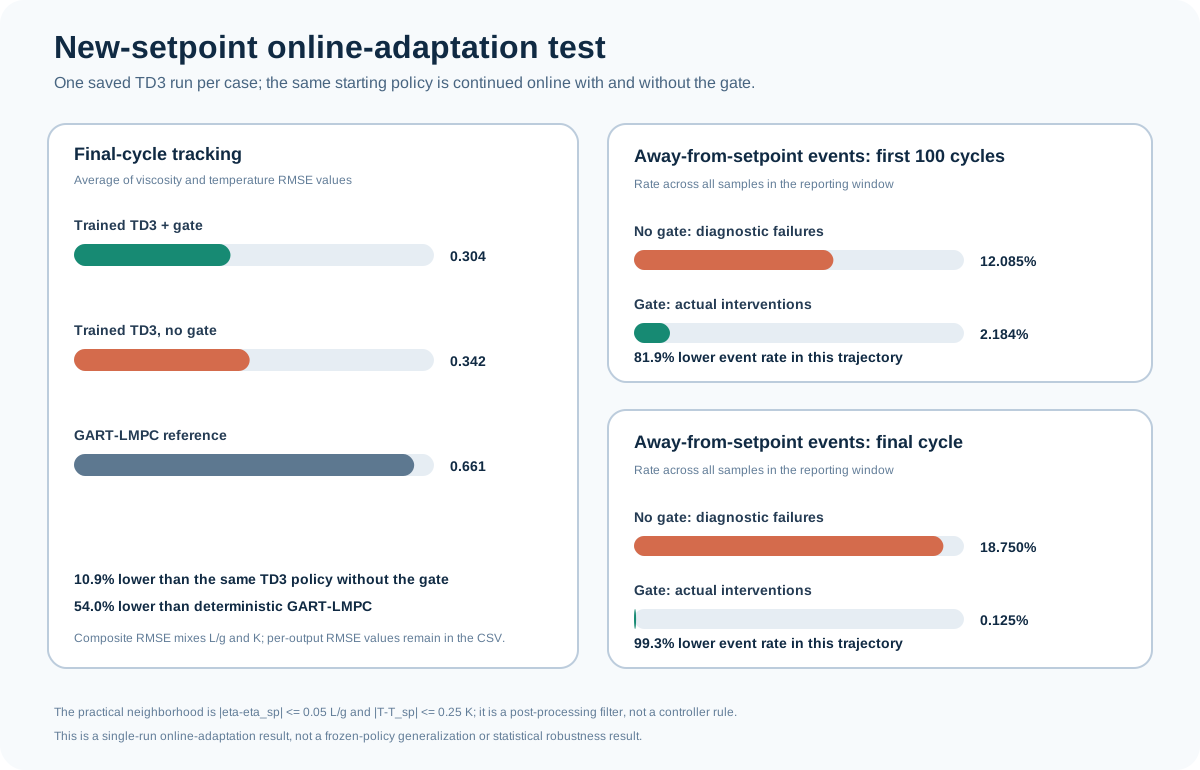
In one continued-online-learning new-setpoint test, final-cycle gated-TD3 RMSE was 0.0965 L/g for viscosity and 0.512 K for temperature, compared with 0.1169 L/g and 0.566 K without the gate and 0.2287 L/g and 1.094 K for deterministic GART-LMPC. Actual gated interventions occurred on 2.18% of samples during the first 100 cycles and 0.125% during the final cycle; the ungated trajectory failed the same diagnostic condition on 12.09% and 18.75% of samples.
Limitations and evidence maturity
The evidence is limited to a nonlinear polymer-CSTR simulation and a local, model-based, one-step acceptance condition; it does not establish laboratory or plant deployment, universal physical safety, global nonlinear stability, recursive feasibility at every step, or production readiness.
Eight-run results are descriptive means and standard deviations without inferential statistics. The new-setpoint comparison uses one continued-online-learning trajectory per case, and its practical neighborhood is a post-processing threshold rather than a controller rule or theorem.